The Rise, Stall, and Future of Smartphone Photo Printers: Why Mini Prints Caught Fire—and What Might Be Next

They weren’t meant to compete with digital. They were a rebellion against it.

Smartphone photo printers—tiny, portable, often stylish devices—emerged in the late 2010s as an answer to a growing problem: we had more photos than ever, but nothing physical to show for them.

They didn’t promise perfection. They promised presence.
A physical keepsake from a night out. A tangible memory taped to a mirror. A moment you could hold.

For a few years, these mini printers were everywhere—Instagram darlings, dorm room essentials, and the go-to gift for anyone under 30.

But in 2025, their presence is fading again. They’re still around, still fun—but they’ve never become mainstream, and their future is uncertain.

So what happened?
Let’s rewind.


The Boom: Tiny, Tangible, and Trendy (2017–2021)

Smartphone photo printers like the HP Sprocket, Canon Ivy, Polaroid Zip, and Fujifilm Instax Mini Link started hitting shelves in the late 2010s. Their pitch was simple:

  • Print your phone photos instantly
  • No ink, no mess—most used ZINK (Zero Ink) or instant film
  • No cords needed—just connect via Bluetooth
  • Fits in your bag—take it to parties, weddings, road trips

And it worked. These printers:

  • Capitalized on nostalgia for Polaroids and scrapbooking
  • Rode the wave of Instagram culture, where aesthetic was everything
  • Made memories feel more personal than sending a Snapchat or uploading to the cloud

Gen Z and millennials especially embraced them. You’d take a selfie, print it on the spot, and hand it to a friend. It felt retro. It felt thoughtful. It felt real.


The Stall: When the Novelty Wore Off

By 2023, things started slowing down.
Smartphone printers didn’t crash—but they plateaued.

1. Prints Got Expensive

At around 50¢–$1 per print, using one regularly added up. And since most prints were just for decoration or keepsakes, many people stopped refilling once the novelty wore off.

2. Print Quality Was Just Okay

ZINK printers had dull colors, odd contrast, and less sharpness than digital screens.
Even instant film printers had inconsistencies that were charming once—but frustrating after a while.

3. App Friction

Every printer had its own app. Some were buggy, slow to connect, or bloated with unnecessary editing tools. The workflow never felt as instant as the name implied.

4. Social Habits Changed

As TikTok and vertical video took over, printed still photos lost cultural dominance. People shifted toward dynamic memories—Reels, Stories, vlogs.
Physical prints started feeling static, even when beautifully arranged on a wall.

5. Sustainability Concerns

The use of single-use film, non-recyclable photo paper, and battery-powered devices raised concerns. For a generation that values sustainability, that started to matter.


2025: Where We Are Now

Today, mini photo printers are still around, but they’re no longer buzzy.

  • Fujifilm Instax Mini Link 2 leads the market, combining AR features, video QR codes, and great film quality.
  • HP Sprocket and Canon Ivy are still sold, but updates are rare, and innovation has slowed.
  • Polaroid’s Hi-Print offers dye-sub quality but hasn’t broken out.

Smartphone printers remain popular for specific use cases:

  • Weddings, events, and photobooths
  • Crafting and journaling
  • Gifts and instant souvenirs
  • Travel documentation in physical journals

But they’ve become niche gadgets, not must-haves.


What’s Next: Can They Make a Comeback?

There’s still a future for smartphone printers—if they evolve with purpose.

1. Smarter, Integrated Apps

Imagine printers that auto-curate your best shots, remove duplicates, and suggest layouts—saving you the effort of hunting through 40,000 screenshots.

2. Eco-Friendly Printing

Look for recyclable film cartridges, refillable ZINK options, or plant-based photo paper to appeal to sustainability-conscious users.

3. Dynamic Print Tech

Some brands are experimenting with video-linked prints—where you scan a photo and it plays a moment back via AR or a QR-linked video.

4. More Affordable Ecosystems

If printing became cheaper per shot—or subscription-based—it could reinvigorate interest, especially among teens and parents.

5. New Use Cases

In education, therapy, memory care, or travel journaling, the power of physical images still resonates.
Future printers could become tools for mindfulness, storytelling, or creative expression, not just souvenirs.


The Takeaway: Smartphone Photo Printers Didn’t Fail—They Just Found Their Lane

They were never going to replace digital photos.
But they offered something else—a tangible reminder in an intangible world.

In 2025, they’re not essential. But they’re still loved—quietly, creatively, and occasionally beautifully.

And in a world that moves too fast, that might be enough.
One print at a time.

💰 I Tried the World’s Cheapest Smartwatch ($8?!) – Here’s What Happened

Ever wonder if you could stop being lazy and unhealthy without dropping hundreds of dollars? Turns out, you can—even if you’re broke.

Enter the world’s cheapest smartwatch. I paid around $8 for it (you can grab it now for about $20). When I got it, I expected a joke. But what I found actually shocked me.

📦 What’s in the box?

Simple and barebones:

  • The watch itself
  • A USB charger
  • A manual (I think? I didn’t really need it)

Setup was stupidly easy. Faster than some premium watches I’ve tried.

🩹 The Fitbit Killer?

Quick backstory: I used to own a Fitbit. It made my wrist glow red and irritated my skin, then broke way too early. So I assumed this $8 watch would be a disaster. Nope.

This thing is:

  • Way more comfortable than any watch I’ve worn
  • Fully adjustable with a soft, lightweight band
  • Better than even my normal everyday watch
  • No skin irritation at all, even after a week of wearing it daily

🖥 Apple Watch vibes… for $8?!

No, you can’t download apps like on an Apple Watch. But let’s be honest—how many Apple Watch features are you REALLY using anyway?

This is like the stripped-down version of a smartwatch, but it nails the essentials:

  • Tons of default & customizable watch faces (hundreds available via the free app)
  • Display of steps, weather, calories, miles walked, and more—all right on the home screen

Responsiveness

Swipe in any direction, use the side dial, and everything just works. The response speed? Feels like an Apple Watch. I’m serious. ZERO glitches.

🔥 Feature Bomb

This is where it gets crazy. Here’s just a fraction of what this $8-$20 watch can do:
✅ Step tracking
✅ Distance + calorie counting
✅ Heart rate & blood oxygen monitoring
✅ Stress level tracking
✅ Automatic sleep tracker
✅ Alexa integration
✅ Music control
✅ Phone call support
✅ Flashlight
✅ Full phone notifications (texts, Snapchats, etc.)
✅ Reminders, timers, alarms
✅ Weather forecast
✅ Water drinking plan
✅ Weight tracking
✅ Blood sugar management
✅ Menstrual cycle tracking
✅ V2 Max (I don’t even know what that is)
…and more—all for free, inside the app.

For the price? Mind-blowing.

🧪 Does it actually work though?

I put it to the test. Steps? Accurate. Heart rate and stress level? Matched what I was feeling and doing every time. Sleep tracker? Worked like a charm.

Nothing has glitched or miscalculated after a week of daily use.

🔋 Battery Life Test

I charged it ONCE when I first unboxed it. After 7 full days of wearing it off and on? Still at 78%. WHAT?!
That means you can track your sleep AND your daily steps without worrying about charging it at night or halfway through your day.

🏃 Workout Test

Set a 5-minute outdoor run goal → Ran → Came back → Boom, stats displayed instantly. The app even recommended a 7-hour recovery period based on my data (rude but probably true).

The Verdict

I love this watch. It’s simple, comfortable, and wildly overdelivers for the price. I usually don’t stick with smartwatches because they’re overpriced—but this one? No-brainer. It works, it’s dirt cheap, and it doesn’t come with all the bloat that makes expensive watches annoying.

Honestly, even if this thing cost $100+ I’d still be impressed. At around $20? This is a steal.


👉 Want to grab it too? Here’s the link: Cheapest Good SmartWatch

Go do something you love today—and maybe track it with this watch 😉

Thanks for reading!

Can Smart Glasses Teach You a NEW LANGUAGE in 24 HOURS? | Ray-Ban Meta Language Challenge

Learning a new language usually takes months or years—unless you’re wearing Ray-Ban Meta smart glasses with an AI voice assistant feeding you translations all day. I decided to put this futuristic language hack to the test.

The mission:

  • No English allowed.
  • Only Italian (which I don’t speak at all).
  • And by the end, I must understand Meta speaking to me in full Italian.

The Setup

In high school, three years of Spanish classes left me with little more than the ability to order tacos badly. Yet, when I studied abroad and learned Arabic, I noticed something: no textbooks, no alphabet, no writing—just listening and speaking. That approach stuck.

So, could Ray-Ban Meta glasses, powered by AI, pull off a similar feat?


Phase 1: Small Talk Crash Course

Like any language learner, the first step was survival phrases. I asked Meta for simple greetings:

  • “Buongiorno!” (Good morning)
  • “Come stai?” (How are you?)
  • And, of course, “Subscribe, Per l’algoritmo di YouTube!” (For the YouTube algorithm!)

Sure, I butchered the pronunciation, but repetition with an AI tutor glued to your face? Surprisingly effective.


Phase 2: Testing in the Wild

Feeling slightly overconfident, I tried these phrases on unsuspecting strangers. At 7 AM. Spoiler: no one cared.

Next, I took it to the kitchen.

  • “Mela” (apple)
  • “Piano” (slowly)
  • And my favorite: “El piano è fuori di mela” (The piano is out of apples… wait, what?)

Things got weird fast. But something else happened too. I started remembering words without checking my glasses every 5 seconds.


Phase 3: Full Immersion Mode

By sunset, I was deep in Italian culture:

  • Wearing an Italian-inspired outfit.
  • Making homemade gnocchi.
  • Watching soccer while screaming at the TV like an unhinged Serie A superfan.

I wasn’t just learning Italian words—I was feeling Italian.


The Final Test: Meta Speaks to Me (In Italian)

No more English. I switched my Meta AI assistant to full Italian mode. Could I understand what she was saying?

The result? Surprisingly… yes. Broken phrases, sure. But enough context clues and remembered vocab helped me navigate my final conversation with ease. “Sì, capisco!” I yelled triumphantly.


Verdict: Can Smart Glasses Teach You a Language Fast?

✅ Immersive? Yes.
✅ Fun? Definitely.
✅ Fluent in 24 hours? Not quite, but you’d be shocked how much sticks when an AI is coaching you in real time, whispering Italian sweet nothings in your ear all day.

Ray-Ban Meta glasses won’t replace full language courses, but as a daily immersion tool, they’re like having a personal Italian coach on your head 24/7.

👉 Check them out here (affiliate)


Would you try learning a language with smart glasses? 🇮🇹🕶️

Ray-Ban Meta Smart Glasses in 2025: Integrating In-Lens Displays and the Path to Augmented Reality


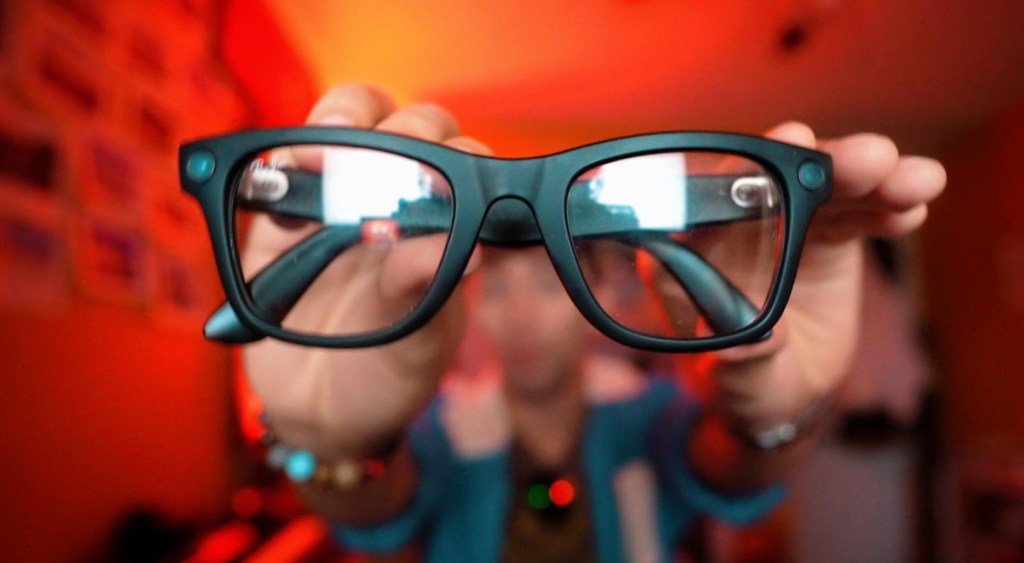
When Ray-Ban Meta smart glasses launched in 2023, they were a stylish, surprisingly powerful mix of camera glasses and a wearable assistant. Fast-forward to 2025, and these glasses are inching toward something much bigger: true augmented reality. With Meta now preparing to add tiny displays inside the lenses themselves, we’re seeing the start of a fundamental shift—from passive smart glasses to immersive, everyday computing devices.

Let’s break down how we got here, what’s new in 2025, and what Meta’s long-term vision looks like.


2023: Smart Glasses Become a Real Assistant

In September 2023, Meta and Ray-Ban launched the second generation of their smart glasses—the Ray-Ban Meta series. This wasn’t just an upgrade in style or battery life. It marked the true beginning of Meta’s vision for smart eyewear:

  • A Better Camera: The new 12MP camera allowed users to take higher-resolution photos and record videos up to 60 seconds, compared to the 30-second limit on the first model.
  • Stronger Audio System: With five microphones, the glasses offered clearer calls and more accurate voice pickup, even in noisy environments.
  • Meta AI: This was the game changer. The built-in assistant could respond to voice commands, answer basic questions, send messages, and control music or calls—all triggered by a simple “Hey Meta.”
  • Customization: Over 150 frame and lens combinations gave users more options to personalize their look while staying connected.

By the end of 2023, creators, travelers, and everyday users began realizing that these weren’t just camera glasses—they were wearable assistants.


2024: The Year Everything Got Smarter

In 2024, the glasses received the biggest leap forward yet: they started to understand what you were seeing.

April 2024: Meta AI with Vision

Meta rolled out an update that gave the glasses visual awareness. With “Meta AI with Vision,” you could:

  • Ask, “What am I looking at?” and get information about buildings, objects, animals, and more.
  • Get real-time translations by looking at a sign or menu in another language.
  • Get memory support, like asking “Where did I park?” and having the glasses recall what they saw.
  • Use contextual assistance—the AI could understand what you were doing or looking at and offer help in the moment.

This wasn’t just an assistant anymore. It was starting to behave like a basic visual AI companion.

September 2024: Deeper AI and App Integration

Later that year, Meta delivered even more powerful updates:

  • Conversational Awareness: You could talk to the glasses naturally, without needing to say “Hey Meta” repeatedly. It remembered the context of your questions.
  • Video-based AI Help: You could record or live-stream what you were seeing and ask Meta AI questions about it—like a walking tour with a genius guide.
  • Voice Messaging & Hands-Free Communication: You could send messages through WhatsApp and Messenger using just your voice.
  • Media Control: Integrations with Spotify, Amazon Music, Audible, and others made it easy to play music or audiobooks, identify songs, and even get music suggestions—all through voice.
  • Third-Party Expansion: Meta began collaborating with more developers to build new apps and tools directly into the glasses experience.

2024 showed that Meta was no longer just improving hardware—it was turning the glasses into a complete AI ecosystem.


2025: In-Lens Displays and the First Step into AR

This year, Meta is preparing to release the biggest hardware upgrade yet: micro-displays built right into the lenses.

Here’s what we know:

  • What They’ll Do: These tiny displays will show basic visuals like incoming messages, navigation prompts, or reminders, all directly in your line of sight—without needing to check your phone.
  • How They’ll Work: Meta is working with Luxottica to embed ultra-thin display tech into the lenses without making the glasses bulky or uncomfortable. The goal is to retain the Ray-Ban style while adding next-gen utility.
  • Who Gets Them: These features are not just a software update. They’ll only be available in a new, high-end model of the Ray-Ban Meta smart glasses, expected to release in late 2025. The price is rumored to be around $1,000, a major jump from the $300 base model.
  • Not Quite Full AR (Yet): These in-lens displays are not the same as full AR (which would require 3D mapping, spatial anchors, and interaction). But they are the foundation—a way to build up everyday utility before Meta introduces something like the long-rumored “Orion” AR glasses.
  • Meta’s Strategy: By gradually integrating AI, visual context, and now micro-displays, Meta is onboarding users step-by-step into a future where glasses don’t just record what you see—they enhance it in real-time.

Ray-Ban Meta smart glasses have gone from stylish camera gadgets to context-aware voice assistants to early-stage AR devices—all within two years. With in-lens displays set to arrive by the end of 2025, Meta is taking its boldest step yet toward glasses that don’t just let you capture the moment, but live more intelligently inside it.

And this is just the beginning.

If you’d like to check out the current Ray Ban Meta glasses, you can purchase them here (affiliate)!