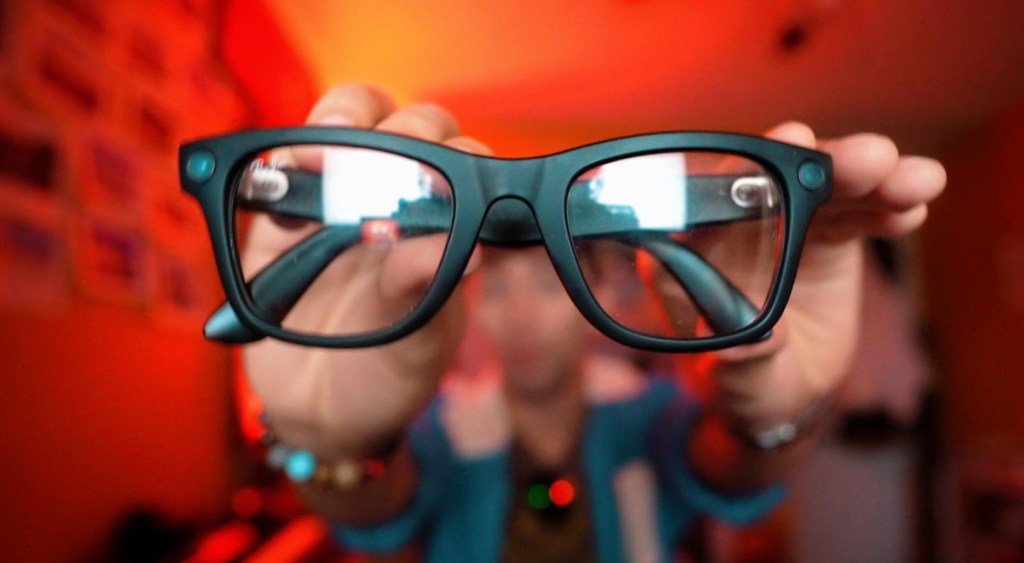
If you travel often and don’t have Ray-Ban Meta Smart Glasses yet, you might seriously be missing out. After using them on multiple trips, I can confidently say they’ve become a must-pack essential for me—and here’s why.
1. The Ultimate POV Camera (Better Than a GoPro)
Ever wish you could capture amazing first-person footage without the hassle of holding a camera? Whether you’re riding a roller coaster, paragliding, zip-lining, or biking with no hands, these glasses are a game-changer. Unlike GoPros, they don’t require bulky mounts, cases, or extra gear. The footage looks incredible—better color, better audio (since they aren’t trapped in a plastic housing), and you stay completely hands-free. Plus, let’s be honest: they’re way more discreet than strapping a camera to your head.
You can check them out here or opt for a cheaper alternative here.
2. Instant On-the-Go Translation
These glasses come equipped with AI capabilities that make navigating foreign countries much easier. Just say, “Translate this,” and they’ll snap a photo, process the translation, and read it quietly into your ears—no one around you will hear it. No more fumbling with your phone’s translation apps or feeling awkward trying to sound out signs and menus. It feels like having a personal interpreter built into your sunglasses. Pro tip: you can even disable the “Hey Meta” wake word so they’re always listening when you need them.
3. All-in-One Travel Companion
These aren’t just a camera or a translator—they’re also your backup headphones, your AI assistant, and your sunglasses, all in one. Forgot your AirPods on the plane? No problem. These glasses can stream your music directly. Need to make a hands-free call while walking through a busy market? Done. Oh, and since they automatically turn into sunglasses when you step outside, there’s one less item to pack.
Honestly, I don’t regret bringing these on any trip—but I do regret not owning them sooner. I could’ve saved myself a ton of hassle and captured so many more epic moments along the way.
If you’re someone who travels regularly, loves gadgets, or just wants to simplify your travel gear, these smart glasses are worth every penny. And with multiple styles and colors (Ray-Ban partnered with Meta to make sure they actually look good), there’s probably a pair that’ll fit your vibe.
Check out the ones I recommend here or the cheaper option here. Safe travels!
The links above are affiliate and support me at no extra cost to you.
When you hear “$5 smart glasses,” your first instinct is probably to laugh. But today, we’re putting a pair of ultra-budget smart glasses head-to-head with the $400 Ray-Ban Meta Smart Glasses, arguably the best smart glasses you can currently buy.
Let’s see how they stack up across design, features, audio quality, and usability.
🕶️ Design – Surprisingly Close
$5 Smart Glasses
Lightweight and minimalistic
No flashy branding
Basic plastic build, similar to cheap sunglasses you’d find on Amazon
Surprisingly clean design with touch controls subtly placed on the side
$400 Ray-Ban Meta Glasses
Premium finish with metal reinforcements
Built-in 1080p camera, 5 microphones, and bone conduction speakers
Charges directly through its included USB-C charging case
Feels more solid, weightier, and purpose-built for long-term wear
Verdict: In terms of pure looks, these two glasses look shockingly similar. The Ray-Bans win in build quality, but for basic fashion points, the $5 pair holds its own.
🎧 Audio Quality – The Shock Factor
$5 Smart Glasses:
Better than expected! Comparable to cheap Bluetooth headphones
A faint static noise when giving voice commands, but music playback sounds fine
Lighter, so they are more comfortable for extended wear
Fast and responsive touch controls
Ray-Ban Meta Glasses:
Exceptional audio quality—better than AirPods Pro
Crystal-clear mids and highs, richer bass
Slight delay in voice assistant response compared to the $5 pair
Seamless volume control via touch-sensitive swipe gestures
Verdict: The Ray-Bans easily take the crown here for sound fidelity, but for casual music or podcasts, the $5 pair is surprisingly capable.
🤖 Smart Features & AI – Worlds Apart
$5 Smart Glasses:
Functions more like a Siri-lite
Voice assistant is quick and responsive
Basic commands like calling, music playback, and simple questions work well
No advanced AI like ChatGPT or deep conversational skills
Assistant voice is actually pleasant—less robotic than expected
Ray-Ban Meta Glasses:
Full AI assistant powered by Meta AI (ChatGPT-based)
Can answer complex questions, tell jokes, help plan your day, and more
Features like POV photo/video capture, live streaming, and advanced gesture control
Truly feels like you’re interacting with a virtual companion
Verdict: While the $5 glasses cover basic functionality well, the Meta glasses are in a league of their own for AI and productivity.
📞 Calling, Comfort & Miscellaneous
Calls: Both glasses can make and take calls hands-free, but mic quality is significantly better on the Ray-Bans.
Comfort: The $5 glasses are lighter and may be more comfortable for all-day use, though they lack durability.
Battery: $5 glasses last longer on a single charge (~5 hours vs. ~3–4 hours for the Ray-Bans), but the Ray-Bans win thanks to the charging case, which extends battery life to 36 hours.
⚖️ The Verdict
$5 Smart Glasses: If you just want sunglasses with basic Bluetooth audio, call capability, and simple voice commands—these will shock you with how much they deliver for almost nothing.
Ray-Ban Meta Glasses: If you’re serious about AI tools, premium sound, POV recording, and deeper interactions, nothing beats them.
If you’re just looking for casual wearables with a few smart features, the $5 glasses are more than enough. But if you want the full smart glasses experience, the Ray-Bans are worth every penny.
When Ray-Ban Meta smart glasses launched in 2023, they were a stylish, surprisingly powerful mix of camera glasses and a wearable assistant. Fast-forward to 2025, and these glasses are inching toward something much bigger: true augmented reality. With Meta now preparing to add tiny displays inside the lenses themselves, we’re seeing the start of a fundamental shift—from passive smart glasses to immersive, everyday computing devices.
Let’s break down how we got here, what’s new in 2025, and what Meta’s long-term vision looks like.
2023: Smart Glasses Become a Real Assistant
In September 2023, Meta and Ray-Ban launched the second generation of their smart glasses—the Ray-Ban Meta series. This wasn’t just an upgrade in style or battery life. It marked the true beginning of Meta’s vision for smart eyewear:
A Better Camera: The new 12MP camera allowed users to take higher-resolution photos and record videos up to 60 seconds, compared to the 30-second limit on the first model.
Stronger Audio System: With five microphones, the glasses offered clearer calls and more accurate voice pickup, even in noisy environments.
Meta AI: This was the game changer. The built-in assistant could respond to voice commands, answer basic questions, send messages, and control music or calls—all triggered by a simple “Hey Meta.”
Customization: Over 150 frame and lens combinations gave users more options to personalize their look while staying connected.
By the end of 2023, creators, travelers, and everyday users began realizing that these weren’t just camera glasses—they were wearable assistants.
2024: The Year Everything Got Smarter
In 2024, the glasses received the biggest leap forward yet: they started to understand what you were seeing.
April 2024: Meta AI with Vision
Meta rolled out an update that gave the glasses visual awareness. With “Meta AI with Vision,” you could:
Ask, “What am I looking at?” and get information about buildings, objects, animals, and more.
Get real-time translations by looking at a sign or menu in another language.
Get memory support, like asking “Where did I park?” and having the glasses recall what they saw.
Use contextual assistance—the AI could understand what you were doing or looking at and offer help in the moment.
This wasn’t just an assistant anymore. It was starting to behave like a basic visual AI companion.
September 2024: Deeper AI and App Integration
Later that year, Meta delivered even more powerful updates:
Conversational Awareness: You could talk to the glasses naturally, without needing to say “Hey Meta” repeatedly. It remembered the context of your questions.
Video-based AI Help: You could record or live-stream what you were seeing and ask Meta AI questions about it—like a walking tour with a genius guide.
Voice Messaging & Hands-Free Communication: You could send messages through WhatsApp and Messenger using just your voice.
Media Control: Integrations with Spotify, Amazon Music, Audible, and others made it easy to play music or audiobooks, identify songs, and even get music suggestions—all through voice.
Third-Party Expansion: Meta began collaborating with more developers to build new apps and tools directly into the glasses experience.
2024 showed that Meta was no longer just improving hardware—it was turning the glasses into a complete AI ecosystem.
2025: In-Lens Displays and the First Step into AR
This year, Meta is preparing to release the biggest hardware upgrade yet: micro-displays built right into the lenses.
Here’s what we know:
What They’ll Do: These tiny displays will show basic visuals like incoming messages, navigation prompts, or reminders, all directly in your line of sight—without needing to check your phone.
How They’ll Work: Meta is working with Luxottica to embed ultra-thin display tech into the lenses without making the glasses bulky or uncomfortable. The goal is to retain the Ray-Ban style while adding next-gen utility.
Who Gets Them: These features are not just a software update. They’ll only be available in a new, high-end model of the Ray-Ban Meta smart glasses, expected to release in late 2025. The price is rumored to be around $1,000, a major jump from the $300 base model.
Not Quite Full AR (Yet): These in-lens displays are not the same as full AR (which would require 3D mapping, spatial anchors, and interaction). But they are the foundation—a way to build up everyday utility before Meta introduces something like the long-rumored “Orion” AR glasses.
Meta’s Strategy: By gradually integrating AI, visual context, and now micro-displays, Meta is onboarding users step-by-step into a future where glasses don’t just record what you see—they enhance it in real-time.
Ray-Ban Meta smart glasses have gone from stylish camera gadgets to context-aware voice assistants to early-stage AR devices—all within two years. With in-lens displays set to arrive by the end of 2025, Meta is taking its boldest step yet toward glasses that don’t just let you capture the moment, but live more intelligently inside it.
And this is just the beginning.
If you’d like to check out the current Ray Ban Meta glasses, you can purchase them here (affiliate)!
In the world of smart glasses, the Ray-Ban Meta stands as a premium option, renowned for its sleek design and impressive functionality. But can a pair of $40 smart glasses really compete with the Ray-Ban Meta’s $400 price tag? Let’s dive into a detailed comparison to see how these budget-friendly glasses stack up against the high-end Ray-Ban Meta models.
The Contenders
Ray-Ban Meta Smart Glasses: Known for their stylish design, high-quality video recording, and seamless integration with various apps, these smart glasses come in three models:
$40 Smart Glasses: A budget-friendly option that promises functionality at a fraction of the cost. Check them out here.
Unboxing and First Impressions
Ray-Ban Meta Smart Glasses:
Design: Sleek and modern, with a premium feel.
Build Quality: Solid construction with high-quality materials.
Features: Integrated cameras and microphones for recording videos and making calls.
$40 Smart Glasses:
Design: Basic and less polished.
Build Quality: Lightweight and simple, but less durable.
Features: Basic functionality, with a more noticeable blue tint on the lenses.
The $40 smart glasses come with a basic plastic case and accessories like a manual and a micro USB charger. They are notably lighter and more discreet than the Ray-Ban Meta glasses, but the quality of materials is less refined.
Comfort and Fit
Ray-Ban Meta Smart Glasses:
Comfort: Generally well-fitted with a snug feel, available in two sizes (normal and large).
Usage: Comfortable for extended wear, even during physical activities.
$40 Smart Glasses:
Comfort: Lightweight and generally comfortable, but they feel less secure during movement.
Usage: Suitable for casual wear but might fall off during vigorous activity.
Charging and Usability
Ray-Ban Meta Smart Glasses:
Charging: Uses a case that charges the glasses, offering convenience and reducing cable clutter.
Buttons and Controls: Touch-sensitive controls for recording and managing settings.
$40 Smart Glasses:
Charging: Requires direct micro USB connection, which can be less convenient.
Buttons and Controls: Simple button operation for turning on and recording.
Video and Audio Quality
Ray-Ban Meta Smart Glasses:
Video Quality: High-definition video recording with a professional feel, excellent for creating content.
Audio Quality: Clear and crisp audio, ideal for recording and calls.
$40 Smart Glasses:
Video Quality: Lower resolution and less clarity, with noticeable color distortions and poor performance in various lighting conditions.
Audio Quality: Inferior compared to the Ray-Ban Meta, with noticeable background noise and reduced clarity.
Pros and Cons
Ray-Ban Meta Smart Glasses:
Pros: Superior build quality, better video and audio performance, stylish design, and seamless functionality with apps and phone calls.
Cons: Higher price point and less discreet in terms of design.
$40 Smart Glasses:
Pros: Much more affordable, lightweight, and discreet. Records video horizontally, which might be preferred for some users.
Cons: Poor video and audio quality, less comfort, and inconvenient charging method.
The Verdict
While the $40 smart glasses offer significant savings and are a viable option for casual users, they fall short in comparison to the Ray-Ban Meta’s quality and functionality. The Ray-Ban Meta glasses are clearly superior in terms of video and audio quality, comfort, and overall build. If you’re serious about smart glasses and can afford the investment, the Ray-Ban Meta is the better choice. However, if you’re just experimenting or on a tight budget, the $40 glasses provide basic functionality at a fraction of the cost.
Interested in checking out the smart glasses? Here are the links to both options:
When it comes to merging style, technology, and practicality, the Ray-Ban Meta Wayfarer glasses have set a new standard. Priced under $400, these glasses aren’t just a fashion statement—they are a tech powerhouse. After testing them out for a couple of weeks, I can confidently say they are one of the best purchases I’ve ever made. Below, I’ll break down 17 reasons why these smart glasses are worth every penny and why you might want to consider picking up a pair for yourself. If you’re already curious, you can check them out here.
Now, let’s dive into the 17 reasons why these glasses are an absolute game-changer:
Sleek Design: Unlike most bulky smart glasses, these are so stylish that I didn’t even realize they were smart glasses at first. They fit great and look amazing, breaking the trend of glasses that usually don’t suit me.
Transition Lenses: These glasses go from clear indoors to sunglasses outdoors, making them perfect for any situation. It’s like having two pairs of glasses in one!
Smart Features: With five built-in microphones, these glasses allow you to take calls, listen to music, and even live stream directly from the glasses.
Seamless Video Recording: Capture amazing POV footage with just a press of a button. You don’t need to pull out your phone or GoPro—just hit record and enjoy the moment. And trust me, the video quality is better than my iPhone!
Capture Moments Effortlessly: How many times have you missed capturing a special moment because you didn’t want to pull out your phone? With these glasses, you can record without being distracted or pulled out of the experience.
Perfect for Vloggers: If you’re hesitant about vlogging in public, these glasses make it easy. No need for a bulky setup—just start filming and focus on your experience.
Superior Sound Quality: The audio quality when making calls or listening to music is better than my AirPods! You can hear everything clearly, and others can hear you perfectly too.
Expands Your Creative Potential: The ease of filming with these glasses encourages you to explore new creative angles and shots that you wouldn’t have thought of otherwise.
Low-Key Style: Even if you don’t need the smart features, these glasses are stylish enough to be worn as regular sunglasses. You get all the functionality with none of the bulk.
Prescription-Ready: If you wear glasses, no problem! You can get these with prescription lenses, so they can replace your everyday glasses while adding the extra features.
Perfect for Everyday Use: Whether you need sunglasses or everyday glasses, the Ray-Ban Meta Wayfarer has you covered with their stylish design and transition lenses.
A Treasure Find: Discovering these glasses was like stumbling upon hidden treasure. Once I knew about them, I couldn’t resist—they’re that good.
Travel-Friendly: As a travel camera, these are incredible. Imagine recording your trip hands-free while enjoying the experience fully. It’s the best of both worlds.
Affordable for What You Get: At under $400, these glasses offer much more value compared to other gadgets like GoPros or AirPods. You get video, photos, live streaming, calls, music, and more in one device.
Easy to Use: The smart features are super intuitive. Just press a button, and you’re recording or taking a call. No complicated setup or learning curve.
Versatility: Whether you’re vlogging, capturing special moments, or just listening to music, these glasses can do it all. They’re perfect for both everyday use and creative projects.
A Glimpse Into the Future: As smart glasses evolve, these Ray-Bans feel like a solid investment in the future. They combine a timeless design with cutting-edge technology, making them a great long-term buy. With so much functionality packed into one stylish pair of glasses, they’re hard to beat.
If any of these features sound like something you’d love, check out the Ray-Ban Meta Wayfarers here. Whether you’re into capturing special moments, staying connected, or just want a really cool pair of glasses, these have got you covered.
Disclaimer: The links above are affiliate links so I may earn a small commission at no extra cost to you. Thanks for supporting this small blog!


 The TechWanderer